Case Studies

How to Kill a Brand: Cracker Barrel
Cultural commentary on the Cracker Barrel Rebrand debacle and what it means for the American right.

Heading 1

Heading 2

Heading 3

Heading 4

Heading 5
Heading 6

Lorem ipsum dolor sit amet, consectetur adipiscing elit, sed do eiusmod tempor incididunt ut labore et dolore magna aliqua. Ut enim ad minim veniam, quis nostrud exercitation ullamco laboris nisi ut aliquip ex ea commodo consequat. Duis aute irure dolor in reprehenderit in voluptate velit esse cillum dolore eu fugiat nulla pariatur.

Block quote

Ordered list

  1. Item 1
  2. Item 2
  3. Item 3

Unordered list

  • Item A
  • Item B
  • Item C

Text link

Bold text

Emphasis

Superscript

Subscript

The internet is aflame with takes on the Cracker Barrel rebrand. It appears that Cracker Barrel will take its place in the brand hall of shame, alongside Jaguar and Bud Light, as one of the most significant rebrand failures of all time.
If you’re not terminally online and haven’t been following this situation, here is a news story that basically sums it up from Forbes.
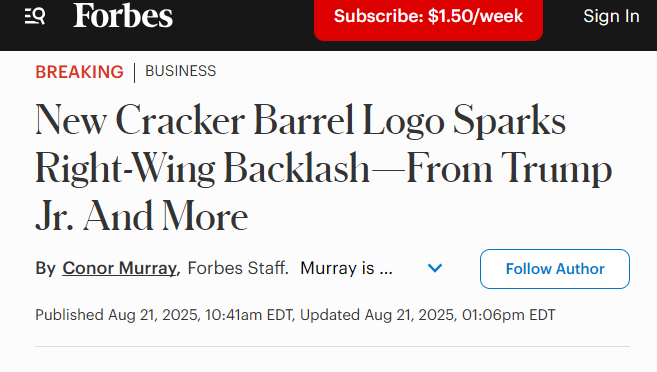
“Conservatives have raged against restaurant chain Cracker Barrel on social media after the brand unveiled a new text-only logo that drops the man and the barrel, with some accusing the company of going “woke” and abandoning its country roots.”

The spin Forbes is putting on this is this: “conservatives got their panties in a wad over a basic business decision and are reading politics into something that’s clearly apolitical. What a bunch of chuds.”

But much ink has been spilt in ire at the flattening of this logo from all sides, and it hasn’t just been from the populist right. Designers debate the merits of flattening the logo vs the loss of “distinctiveness.” The corporate shills discuss the rebrand’s merits from a business perspective.

And these commentaries may contribute something valuable in a sense, but they are missing the meta narrative that makes this whole thing make sense.

As κρῠπτός argues in his essay The True Nature of the Culture War, it is a zero-sum conflict between two fundamentally opposed worldviews, and it’s a war for keeps. There is no sitting on the sidelines. In today’s context, everything is political: the shoes you wear, the car you drive, the watch on your wrist, the books you read. All of it takes on a political charge within this first-order struggle. And this war is fought not with guns (at least not primarily) but with symbols. On one side stand the theater kids and their managerial commissars; on the other, the anonymous meme lords posting from their tenth variation of “howlingmutant.”

Despite Forbes’ weak attempt at gaslighting, the truth is that one can only understand why this rebrand has become a cultural moment within a political frame. Many brands have simplified their logo system. A few of them have gotten critiqued for it. But why is this rebrand such a lightning rod? Only because of its politically symbolic significance.

I will attempt to lay out:

  1. What Cracker Barrel means as a cultural symbol
  2. That this rebrand was politically motivated
  3. How the response shows the American right’s growing political power
  4. What this moment signifies within the broader context of the culture war

Cracker Barrel represents Old America

Cracker Barrel began in 1969 when Dan Evins, a Shell Oil salesman in Lebanon, Tennessee, had the simple idea of pairing gas stations with restaurants that felt like the old country stores he’d grown up around. He built a place where travelers could fuel up their cars and themselves, but more importantly, where they could taste a curated version of small-town America. The barrels of soda crackers by the door, the antiques nailed to every wall, the wooden rocking chairs lined up on the porch. Evins hardwired nostalgia into the business model. Cracker Barrel was designed not just to sell food, but to sell the memory of a community gathering place — a highway outpost where modern mobility met ancestral rootedness. It was, from its founding, a commercial attempt to bottle and brand the very feeling of “country hospitality.”

That’s why it became more than a chain restaurant. Planted along the interstates, it became a ritual stop on road trips, a generational touchstone that made Boomers nostalgic for their childhood and Millennials nostalgic for their grandparents. Even outside the South, Cracker Barrel came to stand for “the heartland,” a cultural shorthand for small-town, conservative America itself.

Old America is Slipping Away

And for millions of Americans, it feels like that world is being stripped away in real time. You may not have ever read a white paper on fiscal policy, but you know downtown is full of meth heads. You know to watch your six when pumping gas. You know to keep your doors locked at night. You know a handshake isn’t enough anymore. Without a contract and a good lawyer, you’re going to get screwed. And if that wasn’t enough, your Grandpa, who used to take you to Cracker Barrel, bought a house at 21 on an entry-level electrician’s salary. Now you’re 38, with a college degree and years of hard work, and you’re still renting.

That America that Cracker Barrel symbolizes is slipping away, and you don’t need to look any further than Cracker Barrel’s own business to see it.

Take a look at this chart.

Fast casual: Chipotle, fine dining: your favorite steakhouse or sushi restaurant, quick service: McDonald’s. Casual dining is Cracker Barrel and Olive Garden.
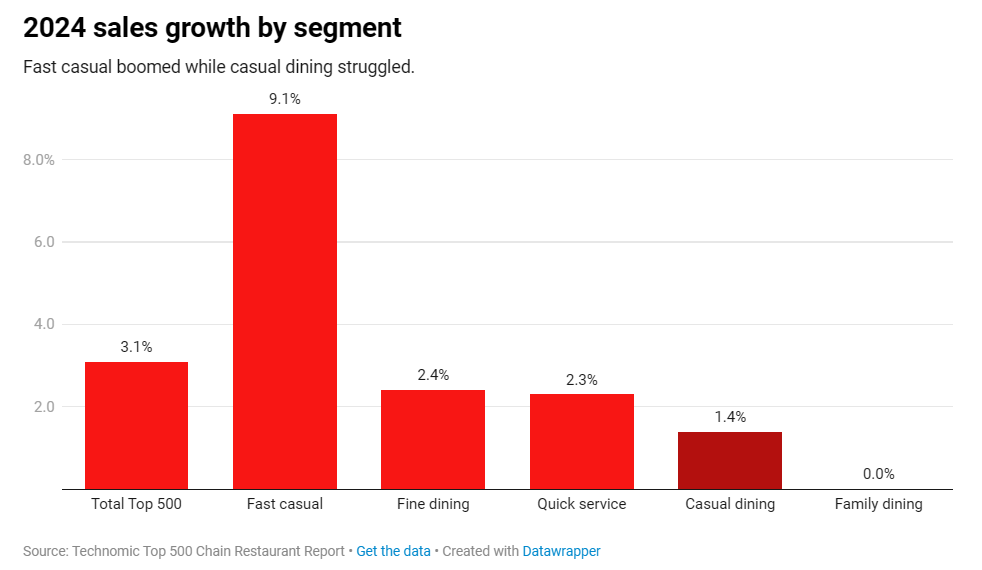
The growth in the fast casual sector is primarily driven by the cost-of-living crisis. Consumers are prioritizing speed, efficiency, and cost because they are working two jobs and trying to cut unnecessary expenses.

Thus, the entire segment of casual dining, within which Cracker Barrel belongs, struggled to produce more than 1.4% growth. And you don’t need to look further than Cracker Barrel’s business to see this quantified further. Cracker Barrel has been performing consistently worse than its competitors, experiencing consecutive quarters of a 4% decline in traffic.

Why? One reason is because their customers are literally dying off. 43% of Cracker Barrel’s guests were 55 or older in 2023. Only 23% were under 34. By contrast, Applebee’s customer base skews 80% under 60.

And really, what Millennial goes to Cracker Barrel? It costs more than Chipotle, takes longer, the dining room feels like a retirement home, and the food is hit or miss.

That’s where this gets really interesting. Cracker Barrel doesn’t just symbolize lost America, it proves it. It points to a time when you could afford the money and the hours to sit down at a diner with your family on a road trip, when the food was only outdone by the service.

Cracker Barrel is a meta-symbol. Cracker Barrel doesn’t merely remind us of a disappearing America; it enacts the disappearance. It was built to symbolize rootedness, trust, and community, and now it decays in real time as it sheds traffic and serves dining rooms full of retirees. It points back to the world we lost and simultaneously demonstrates the reality of that loss. In its decline, Cracker Barrel has become a kind of embodied prophecy: the country store that once sold nostalgia now sells the truth that nostalgia is all that’s left.

Why the rebrand is political

Cracker Barrel is a publicly traded company with P&Ls to consider. Despite the love many consumers have for the country Americana Cracker Barrel represents, its model is under fire, and it needs to reach new customers. Changes to pricing, product, model, and position absolutely should all be on the table in a situation like this.

The board sought a new CEO who could steer the company back to growth.

They found a seemingly perfect candidate. Julie Felss Masino was president of Taco Bell during a particularly strong season of growth (2018-2023). At a time when Taco Bell was faltering, she debuted the incredibly innovative and world-changing Dorito taco, saving the company. Never mind the fact that inflation drove people to the cheapest food imaginable. Never mind the fact that one of Taco Bell’s most faithful customers is America’s fastest-growing population: Hispanics.

But sure. I’m sure it was the Dorito taco.

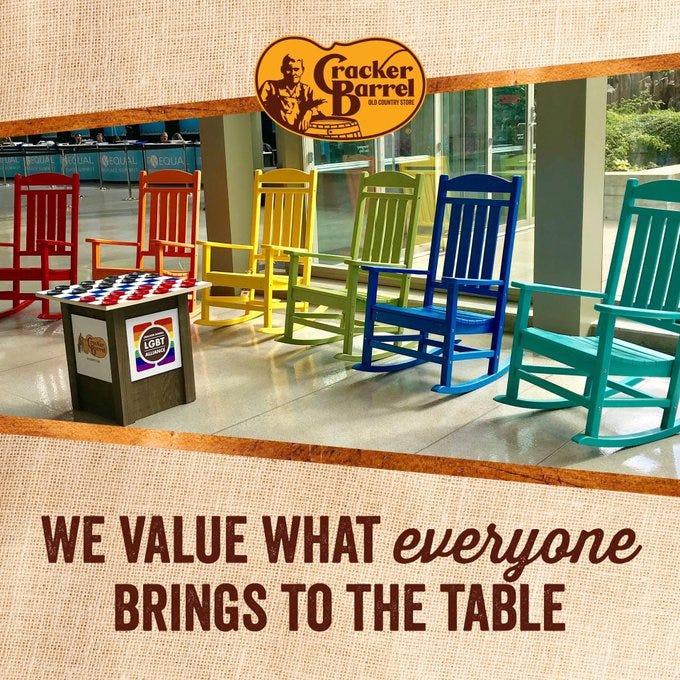
In any case, when she took the helm, anyone who was watching could have seen two things that would have given cause for concern. Firstly, it started virtue signaling hard. This is from the brand that literally fired gay employees for not having “normal heterosexual values” in 1991. In 2023, immediately after Masino took over Cracker Barrel, the company sponsored Nashville Pride, began painting rocking chairs rainbow, and posted inclusivity slogans on social media. For conservatives who once saw Cracker Barrel as a sanctuary of old America, that reversal was a betrayal.
The second signal that there was a problem with how Masino was thinking about the brand came when she gave interviews, saying, “Our brand is just not relevant anymore.”
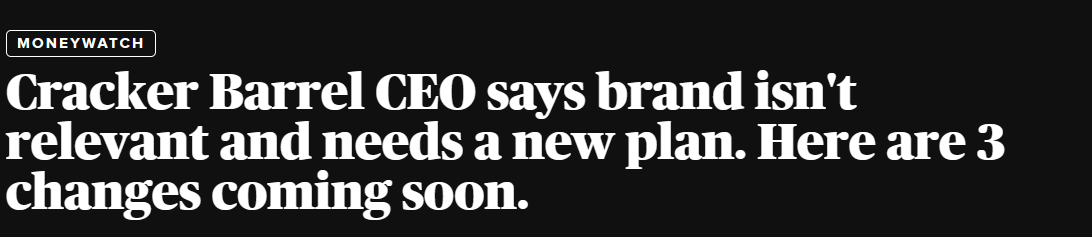
This is a vague, meaningless generality. Relevant to whom? Relevant in what way?

This is precisely the same kind of language used by Alissa Heinerscheid, Vice President of Marketing, used before initiating the Bud Light debacle. Here’s what she said:

“This brand is in decline. It's been in decline for a long time. And if we don't attract young drinkers to come drink this brand, there's going to be no future for Bud Light. ... It's like, we need to evolve and elevate this incredibly iconic brand. And my... what I brought to that was a belief in, okay, what does it mean to evolve and elevate? It means inclusivity. It means changing the tone. It means having a campaign that's truly inclusive and feels lighter, brighter, and different and that appeals to women and men.”

Any time you hear the words “relevant,” “evolve to reach a broader audience,” or “win younger drinkers,” expect that the next campaign is going to be a disaster. The surest way to fail to be relevant is to try to be relevant. The worst way to attract a broad audience is to design for a broad audience. The worst way to win young people is to “try to win young people.”

These are not words for serious people. They are the words of managers who know how to run the pr circuit, how to sound good in board rooms run by boomers, and most importantly, how to climb the corporate ladder. That is the key thing to keep in mind. Women like Masino and Heinerscheid did not achieve their success by being great business women. They are politicians first and businesswomen second.

If these women are so brilliant, so incredible at their jobs, one might wonder why they need to hire companies like Prophet and pay them millions of dollars to come out with pure dogshit.

For those of you who don’t know how this kind of process works, I’ll let Isaac Simpson educate you.

“She hires the stylish agencies so she looks good. In her long career as a commissar, she’s worked at Starbucks, Taco Bell, Mattel, Sprinkles, etc, her job has just been to skate, to managerialize existing “fiefs” so they continue to pay out their crop. She’s never had to create anything good or real, she’s just a gravy train manager. Zero vision or talent.

In any case, the agencies pitch her ideas, and inevitably she chooses the safest ones. Instead of standing up for their better ideas, the agencies tell her “omg yes you’re so amazing” as they make their own ideas blander and blander. Because in reality that is their purpose—they are paid as a bulwark against CEOs ego and reputation taking any damage. Thus any actual good idea that would depart from the norm is seen as scary and threatening and could expose any of them to mockery and exclusion. So they just create the most safe bland thing together, all while convincing each other that they’re all incredible innovators. It’s a mediocrity enforcement ritual.”

See, the reason corporations keep “blanding” and “blending” their identities is because they are, at their core, anti-brand.

Branding is inherently risky, combative, and particular. A brand lives by what it excludes far more than by what it includes. It says: this is who we are, this is what we stand for, this is what we do.

The right understands this. Conservatism at its best is also about particularity. It values rootedness, truth-telling, responsibility, and the willingness to bear burdens. It accepts limits. It draws lines.

The left, by contrast, celebrates universality and flattening. Its corporate expression is “inclusivity,” which sounds wholesome but in practice dissolves the edges that make anything distinctive. That’s why words like “relevance” and “evolution” are code. They don’t mean making a brand stronger; they mean erasing what made it unique in the first place.

If you want to know why everything looks the same, look no further than the word “inclusive.”
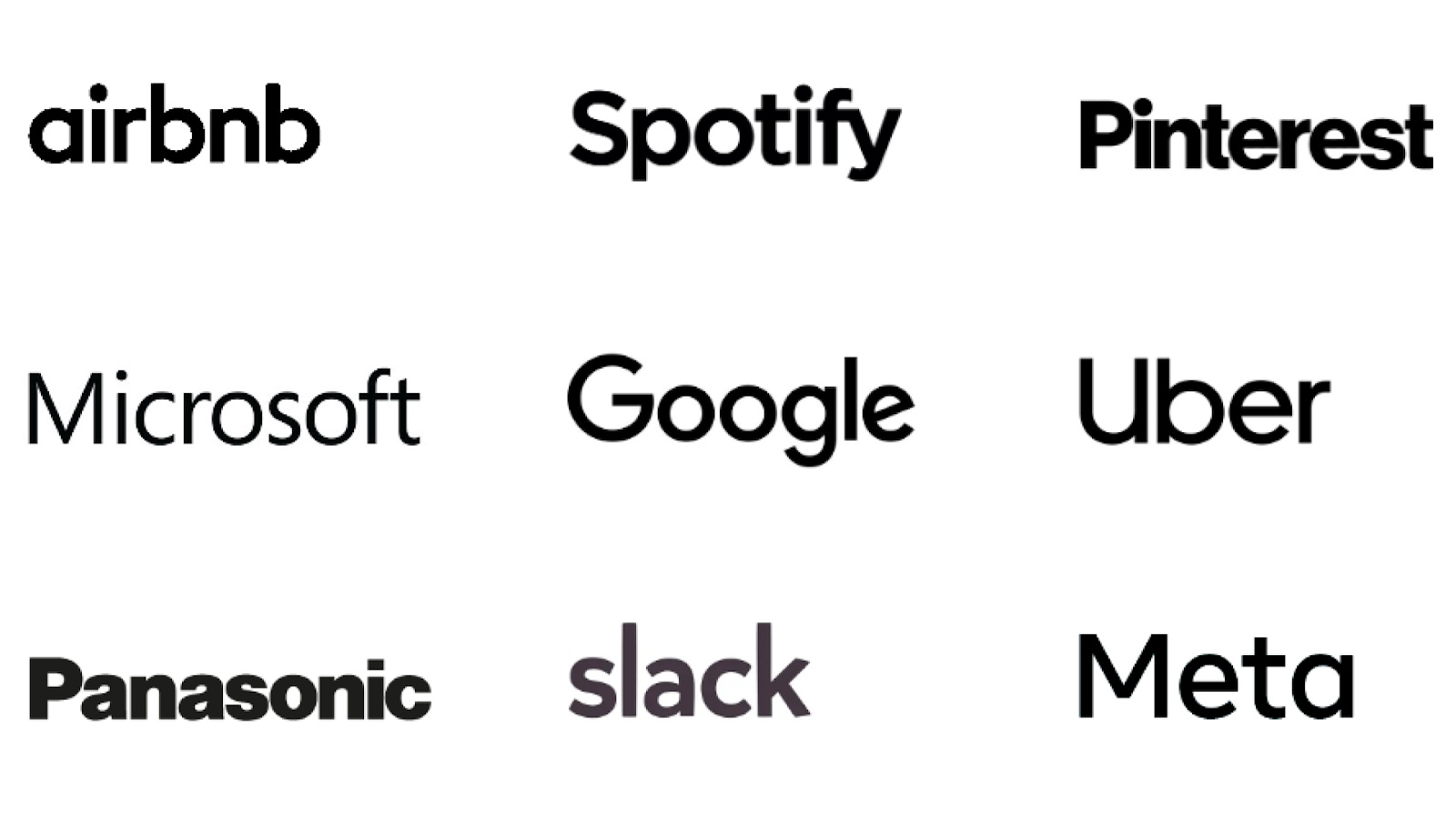
Want to do something cool, edgy, and interesting?

But is it inclusive and accessible tho?

Want to celebrate the particularity of a place like america and a time like the 1960’s?

But is it inclusive and accessible tho?

Sure enough:

Upward News found an interview where Cracker Barrel’s new CEO revealed that the company’s design and logo changes were driven by a push for inclusivity and an effort to appeal to younger generations. The CEO said the goal was to ensure Cracker Barrel is “a place for everyone.”

Now for the big reveal

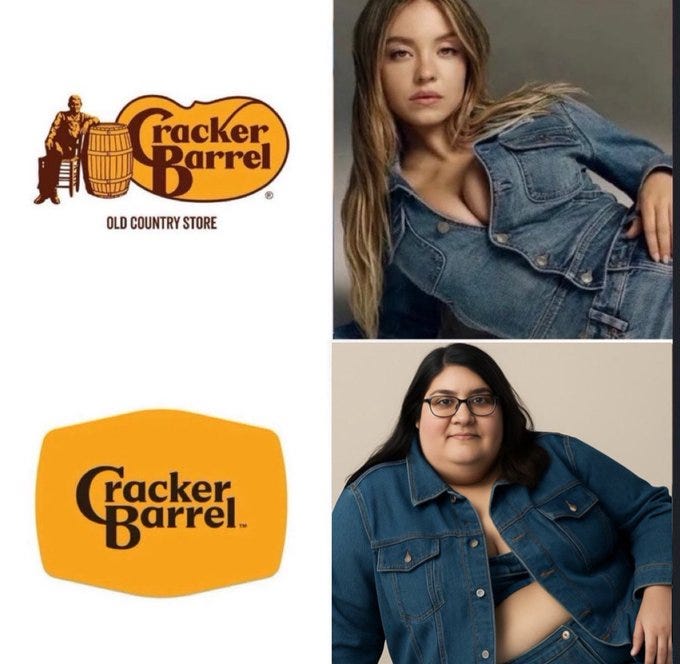
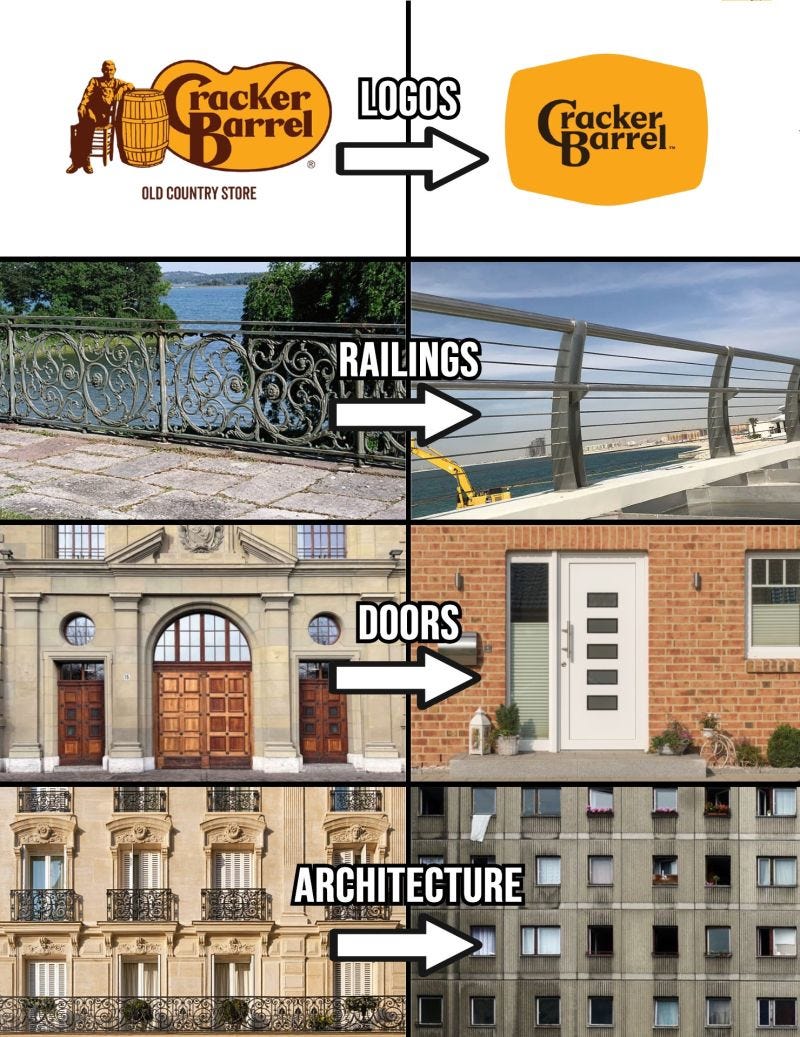
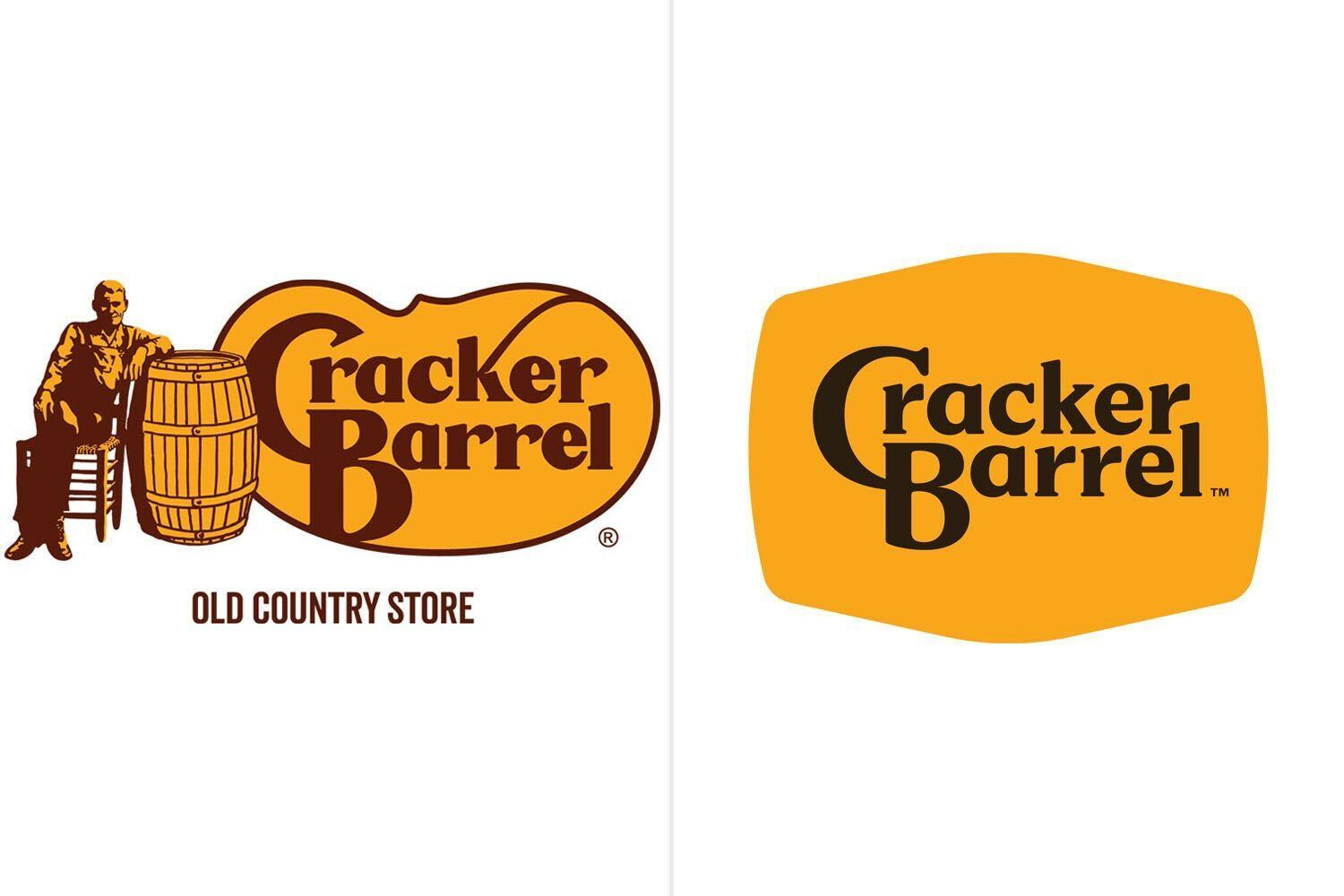
Here’s what Cracker Barrel’s brand language used to look like.
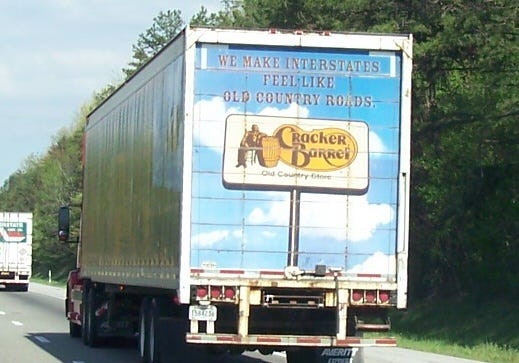
Here’s what it looks like now:

Every ounce of that old country vibe has been removed.

Why?

Inclusivity.

Celebrating a particular culture or a particular place is not inclusive.

A person cannot be the mascot because that’s not inclusive.

As a designer, I don’t hate Cracker Barrel’s new brand. It’s clean, competent, forgettable. If I saw it on a Chipotle spinoff serving “modern American,” I’d think, sure, looks fine. But that’s exactly the problem. It could belong to anyone. It says nothing.

Lest you think that it needed to be this way, look at KFC’s rebrand.

They found a way to evolve the brand for modern marketing uses without destroying its meaning.

But let’s be honest: eventually they’ll come for the Colonel too. In the current system, a white Southern man cannot remain a corporate mascot for long, not when the likes of Masino and Heinerscheid run the boardroom. These girl-bosses’ entire careers depend on neutering particularity.

Because that’s what corporate America hates most: Americans. Real ones. People are attached to their own country, their own neighborhoods, their own history. Patriotism and rootedness are “exclusionary,” and thus must be scrubbed. The executives replacing them aren’t builders; they’re talkers. Their whole job is to sound good: in media hits, in boardrooms, in stakeholder calls. Non-offensiveness isn’t just what their careers are built on; it’s their entire personality.

Which is why this rebrand isn’t just aesthetic. It’s political.

The “chimp out” and what it shows about right-wing power

This is why Americans decided to die on the hill of this rebrand, and they are right to.

There is precious little that the average American can do when confronted with the power of BlackRock and Vanguard.

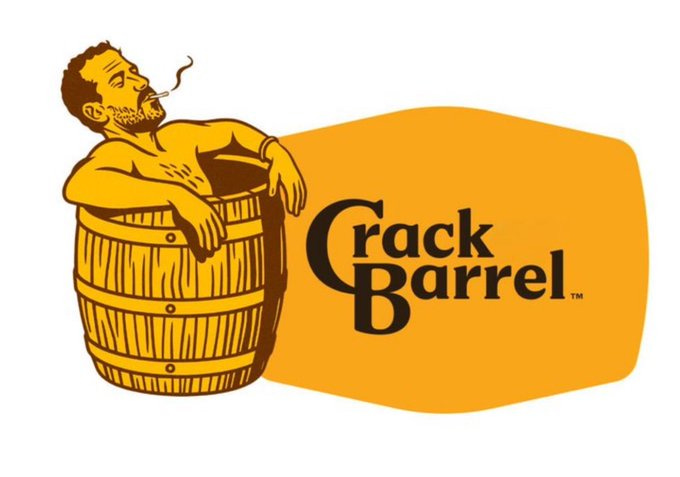
But so long as there is social media, they can storm its beachheads with poasts and memes, the best of which I’ve collected here below:

Not only can Americans vote with their memes, they can also vote with their dollars.

This chimp-out led to a catastrophic 10% drop in stock value, resulting in a $ 200 million loss in a single day.

Despite what the doomers say, the right isn’t losing steam; it’s gaining it. The fact that memelords, online posters, and retail investors can trigger a 10% stock drop in 24 hours is no small thing.

We’re still fighting from the underdog position with the air cover of a free bird and the Trump regime. Every win must be celebrated and capitalized on. The energy may have already shifted to the next outrage, but the signal was clear: America spoke.

How Cracker Barrel responds remains to be seen. I wouldn’t bet on an apology… or on the brand’s future.

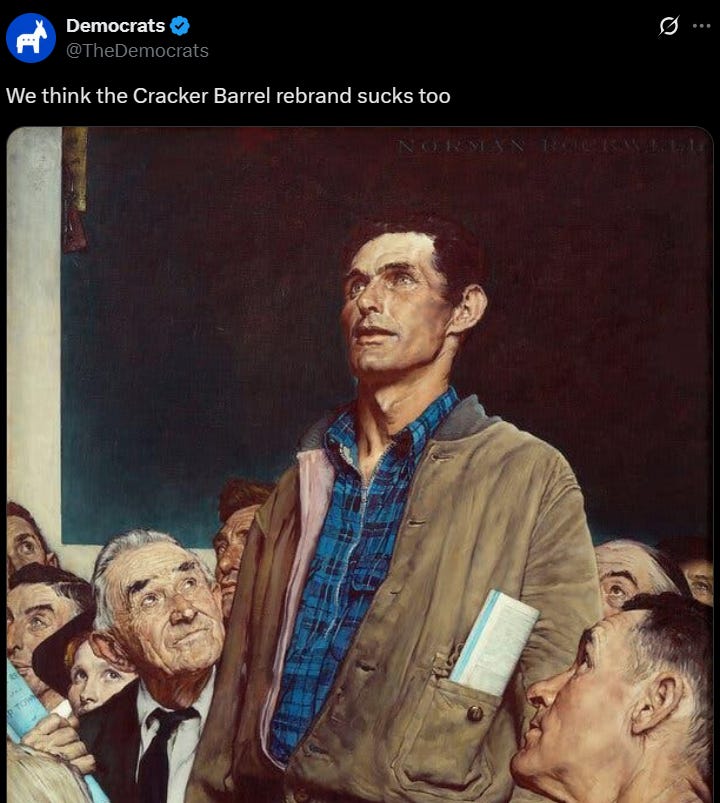
But as the saying goes, everyone loves a winner. In this battle, the right dominated so thoroughly that even the Democrat x account joined the pile-on.

What this victory means in the context of the culture war

Amidst all the hilarity, the sharpest take on this whole debacle came from Auron MacIntyre

“Now you might ask yourself if capitalism is working as intended how does this person come to run Cracker Barrel? That question should keep you up at night.”

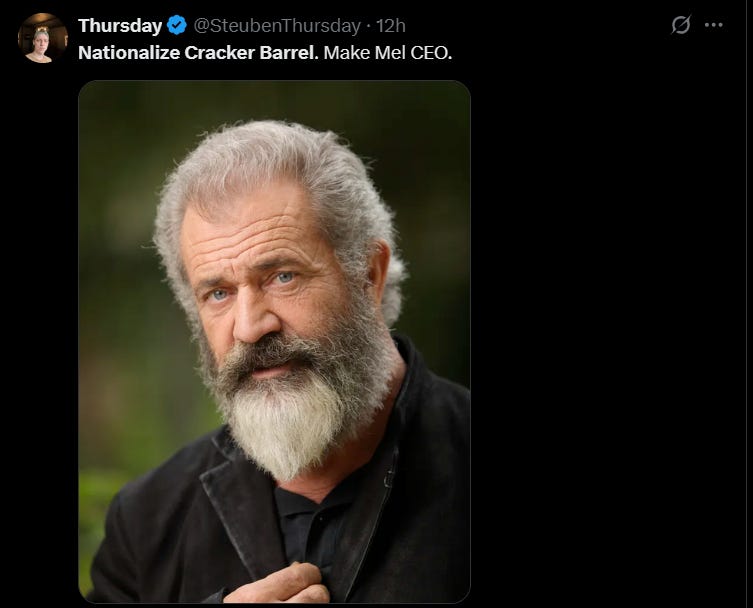
After reading this, I searched, out of curiosity, for “nationalize Cracker Barrel.” What do you know? Hundreds of posts.

If the right is serious about winning, it can’t stop with a four-year stint in Washington. It has to capture every avenue of power. The meme lords understand this instinctively. Their work is more than trolling. They are actively prying open the Overton window for what comes next.

First, with noticing.

Then with jokes.

Then, with action.

Update - 8.22.2025

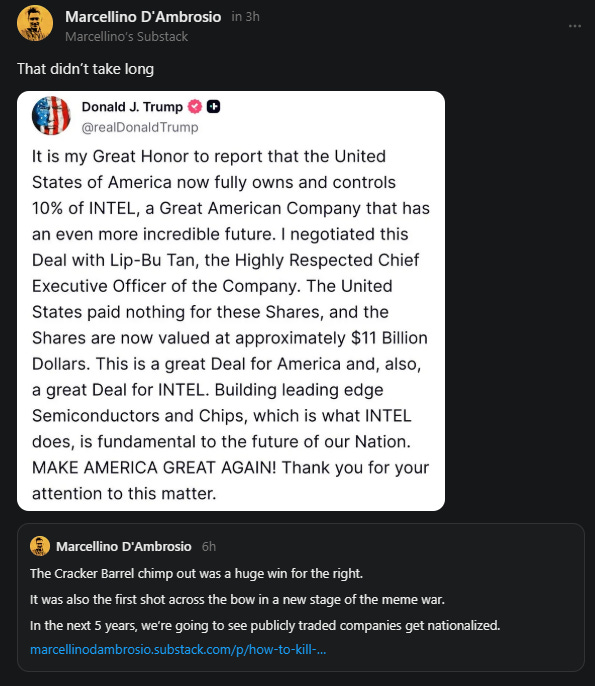
I posted this Substack with a note saying, “In the next 5 years, we’re going to see publicly traded companies get nationalized.”

Not three hours later, Trump announced that the US had taken a controlling 10% interest in Intel.

America’s so-called “free market” is a papier-mache set piece. The populist right is starting to bang on those walls to see if they are real.

We’re about to find out just how flimsy that myth truly is.


“To avoid criticism, say nothing, do nothing, be nothing.”

Aristotle

The internet is aflame with takes on the Cracker Barrel rebrand. It appears that Cracker Barrel will take its place in the brand hall of shame, alongside Jaguar and Bud Light, as one of the most significant rebrand failures of all time.

If you’re not terminally online and haven’t been following this situation, here is a news story that basically sums it up from Forbes.

“Conservatives have raged against restaurant chain Cracker Barrel on social media after the brand unveiled a new text-only logo that drops the man and the barrel, with some accusing the company of going “woke” and abandoning its country roots.”

The spin Forbes is putting on this is this: “conservatives got their panties in a wad over a basic business decision and are reading politics into something that’s clearly apolitical. What a bunch of chuds.”

But much ink has been spilt in ire at the flattening of this logo from all sides, and it hasn’t just been from the populist right. Designers debate the merits of flattening the logo vs the loss of “distinctiveness.” The corporate shills discuss the rebrand’s merits from a business perspective.

And these commentaries may contribute something valuable in a sense, but they are missing the meta narrative that makes this whole thing make sense.

As κρῠπτός argues in his essay The True Nature of the Culture War, it is a zero-sum conflict between two fundamentally opposed worldviews, and it’s a war for keeps. There is no sitting on the sidelines. In today’s context, everything is political: the shoes you wear, the car you drive, the watch on your wrist, the books you read. All of it takes on a political charge within this first-order struggle. And this war is fought not with guns (at least not primarily) but with symbols. On one side stand the theater kids and their managerial commissars; on the other, the anonymous meme lords posting from their tenth variation of “howlingmutant.”

Despite Forbes’ weak attempt at gaslighting, the truth is that one can only understand why this rebrand has become a cultural moment within a political frame. Many brands have simplified their logo system. A few of them have gotten critiqued for it. But why is this rebrand such a lightning rod? Only because of its politically symbolic significance.

I will attempt to lay out:

  1. What Cracker Barrel means as a cultural symbol
  2. That this rebrand was politically motivated
  3. How the response shows the American right’s growing political power
  4. What this moment signifies within the broader context of the culture war

Cracker Barrel represents Old America

Cracker Barrel began in 1969 when Dan Evins, a Shell Oil salesman in Lebanon, Tennessee, had the simple idea of pairing gas stations with restaurants that felt like the old country stores he’d grown up around. He built a place where travelers could fuel up their cars and themselves, but more importantly, where they could taste a curated version of small-town America. The barrels of soda crackers by the door, the antiques nailed to every wall, the wooden rocking chairs lined up on the porch. Evins hardwired nostalgia into the business model. Cracker Barrel was designed not just to sell food, but to sell the memory of a community gathering place — a highway outpost where modern mobility met ancestral rootedness. It was, from its founding, a commercial attempt to bottle and brand the very feeling of “country hospitality.”

That’s why it became more than a chain restaurant. Planted along the interstates, it became a ritual stop on road trips, a generational touchstone that made Boomers nostalgic for their childhood and Millennials nostalgic for their grandparents. Even outside the South, Cracker Barrel came to stand for “the heartland,” a cultural shorthand for small-town, conservative America itself.

Old America is Slipping Away

And for millions of Americans, it feels like that world is being stripped away in real time. You may not have ever read a white paper on fiscal policy, but you know downtown is full of meth heads. You know to watch your six when pumping gas. You know to keep your doors locked at night. You know a handshake isn’t enough anymore. Without a contract and a good lawyer, you’re going to get screwed. And if that wasn’t enough, your Grandpa, who used to take you to Cracker Barrel, bought a house at 21 on an entry-level electrician’s salary. Now you’re 38, with a college degree and years of hard work, and you’re still renting.

That America that Cracker Barrel symbolizes is slipping away, and you don’t need to look any further than Cracker Barrel’s own business to see it.

Take a look at this chart.

Fast casual: Chipotle, fine dining: your favorite steakhouse or sushi restaurant, quick service: McDonald’s. Casual dining is Cracker Barrel and Olive Garden.

The growth in the fast casual sector is primarily driven by the cost-of-living crisis. Consumers are prioritizing speed, efficiency, and cost because they are working two jobs and trying to cut unnecessary expenses.

Thus, the entire segment of casual dining, within which Cracker Barrel belongs, struggled to produce more than 1.4% growth. And you don’t need to look further than Cracker Barrel’s business to see this quantified further. Cracker Barrel has been performing consistently worse than its competitors, experiencing consecutive quarters of a 4% decline in traffic.

Why? One reason is because their customers are literally dying off. 43% of Cracker Barrel’s guests were 55 or older in 2023. Only 23% were under 34. By contrast, Applebee’s customer base skews 80% under 60.

And really, what Millennial goes to Cracker Barrel? It costs more than Chipotle, takes longer, the dining room feels like a retirement home, and the food is hit or miss.

That’s where this gets really interesting. Cracker Barrel doesn’t just symbolize lost America, it proves it. It points to a time when you could afford the money and the hours to sit down at a diner with your family on a road trip, when the food was only outdone by the service.

Cracker Barrel is a meta-symbol. Cracker Barrel doesn’t merely remind us of a disappearing America; it enacts the disappearance. It was built to symbolize rootedness, trust, and community, and now it decays in real time as it sheds traffic and serves dining rooms full of retirees. It points back to the world we lost and simultaneously demonstrates the reality of that loss. In its decline, Cracker Barrel has become a kind of embodied prophecy: the country store that once sold nostalgia now sells the truth that nostalgia is all that’s left.

Why the rebrand is political

Cracker Barrel is a publicly traded company with P&Ls to consider. Despite the love many consumers have for the country Americana Cracker Barrel represents, its model is under fire, and it needs to reach new customers. Changes to pricing, product, model, and position absolutely should all be on the table in a situation like this.

The board sought a new CEO who could steer the company back to growth.

They found a seemingly perfect candidate. Julie Felss Masino was president of Taco Bell during a particularly strong season of growth (2018-2023). At a time when Taco Bell was faltering, she debuted the incredibly innovative and world-changing Dorito taco, saving the company. Never mind the fact that inflation drove people to the cheapest food imaginable. Never mind the fact that one of Taco Bell’s most faithful customers is America’s fastest-growing population: Hispanics.

But sure. I’m sure it was the Dorito taco.

In any case, when she took the helm, anyone who was watching could have seen two things that would have given cause for concern. Firstly, it started virtue signaling hard. This is from the brand that literally fired gay employees for not having “normal heterosexual values” in 1991. In 2023, immediately after Masino took over Cracker Barrel, the company sponsored Nashville Pride, began painting rocking chairs rainbow, and posted inclusivity slogans on social media. For conservatives who once saw Cracker Barrel as a sanctuary of old America, that reversal was a betrayal.

The second signal that there was a problem with how Masino was thinking about the brand came when she gave interviews, saying, “Our brand is just not relevant anymore.”

This is a vague, meaningless generality. Relevant to whom? Relevant in what way?

This is precisely the same kind of language used by Alissa Heinerscheid, Vice President of Marketing, used before initiating the Bud Light debacle. Here’s what she said:

“This brand is in decline. It's been in decline for a long time. And if we don't attract young drinkers to come drink this brand, there's going to be no future for Bud Light. ... It's like, we need to evolve and elevate this incredibly iconic brand. And my... what I brought to that was a belief in, okay, what does it mean to evolve and elevate? It means inclusivity. It means changing the tone. It means having a campaign that's truly inclusive and feels lighter, brighter, and different and that appeals to women and men.”

Any time you hear the words “relevant,” “evolve to reach a broader audience,” or “win younger drinkers,” expect that the next campaign is going to be a disaster. The surest way to fail to be relevant is to try to be relevant. The worst way to attract a broad audience is to design for a broad audience. The worst way to win young people is to “try to win young people.”

These are not words for serious people. They are the words of managers who know how to run the pr circuit, how to sound good in board rooms run by boomers, and most importantly, how to climb the corporate ladder. That is the key thing to keep in mind. Women like Masino and Heinerscheid did not achieve their success by being great business women. They are politicians first and businesswomen second.

If these women are so brilliant, so incredible at their jobs, one might wonder why they need to hire companies like Prophet and pay them millions of dollars to come out with pure dogshit.

For those of you who don’t know how this kind of process works, I’ll let Isaac Simpson educate you.

“She hires the stylish agencies so she looks good. In her long career as a commissar, she’s worked at Starbucks, Taco Bell, Mattel, Sprinkles, etc, her job has just been to skate, to managerialize existing “fiefs” so they continue to pay out their crop. She’s never had to create anything good or real, she’s just a gravy train manager. Zero vision or talent.

In any case, the agencies pitch her ideas, and inevitably she chooses the safest ones. Instead of standing up for their better ideas, the agencies tell her “omg yes you’re so amazing” as they make their own ideas blander and blander. Because in reality that is their purpose—they are paid as a bulwark against CEOs ego and reputation taking any damage. Thus any actual good idea that would depart from the norm is seen as scary and threatening and could expose any of them to mockery and exclusion. So they just create the most safe bland thing together, all while convincing each other that they’re all incredible innovators. It’s a mediocrity enforcement ritual.”

See, the reason corporations keep “blanding” and “blending” their identities is because they are, at their core, anti-brand.

Branding is inherently risky, combative, and particular. A brand lives by what it excludes far more than by what it includes. It says: this is who we are, this is what we stand for, this is what we do.

The right understands this. Conservatism at its best is also about particularity. It values rootedness, truth-telling, responsibility, and the willingness to bear burdens. It accepts limits. It draws lines.

The left, by contrast, celebrates universality and flattening. Its corporate expression is “inclusivity,” which sounds wholesome but in practice dissolves the edges that make anything distinctive. That’s why words like “relevance” and “evolution” are code. They don’t mean making a brand stronger; they mean erasing what made it unique in the first place.

If you want to know why everything looks the same, look no further than the word “inclusive.”

Want to do something cool, edgy, and interesting?

But is it inclusive and accessible tho?

Want to celebrate the particularity of a place like america and a time like the 1960’s?

But is it inclusive and accessible tho?

Sure enough:

Upward News found an interview where Cracker Barrel’s new CEO revealed that the company’s design and logo changes were driven by a push for inclusivity and an effort to appeal to younger generations. The CEO said the goal was to ensure Cracker Barrel is “a place for everyone.”

Now for the big reveal

Here’s what Cracker Barrel’s brand language used to look like.
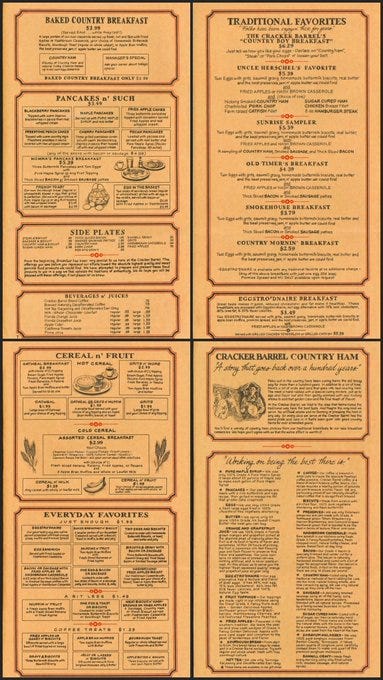
Here’s what it looks like now:
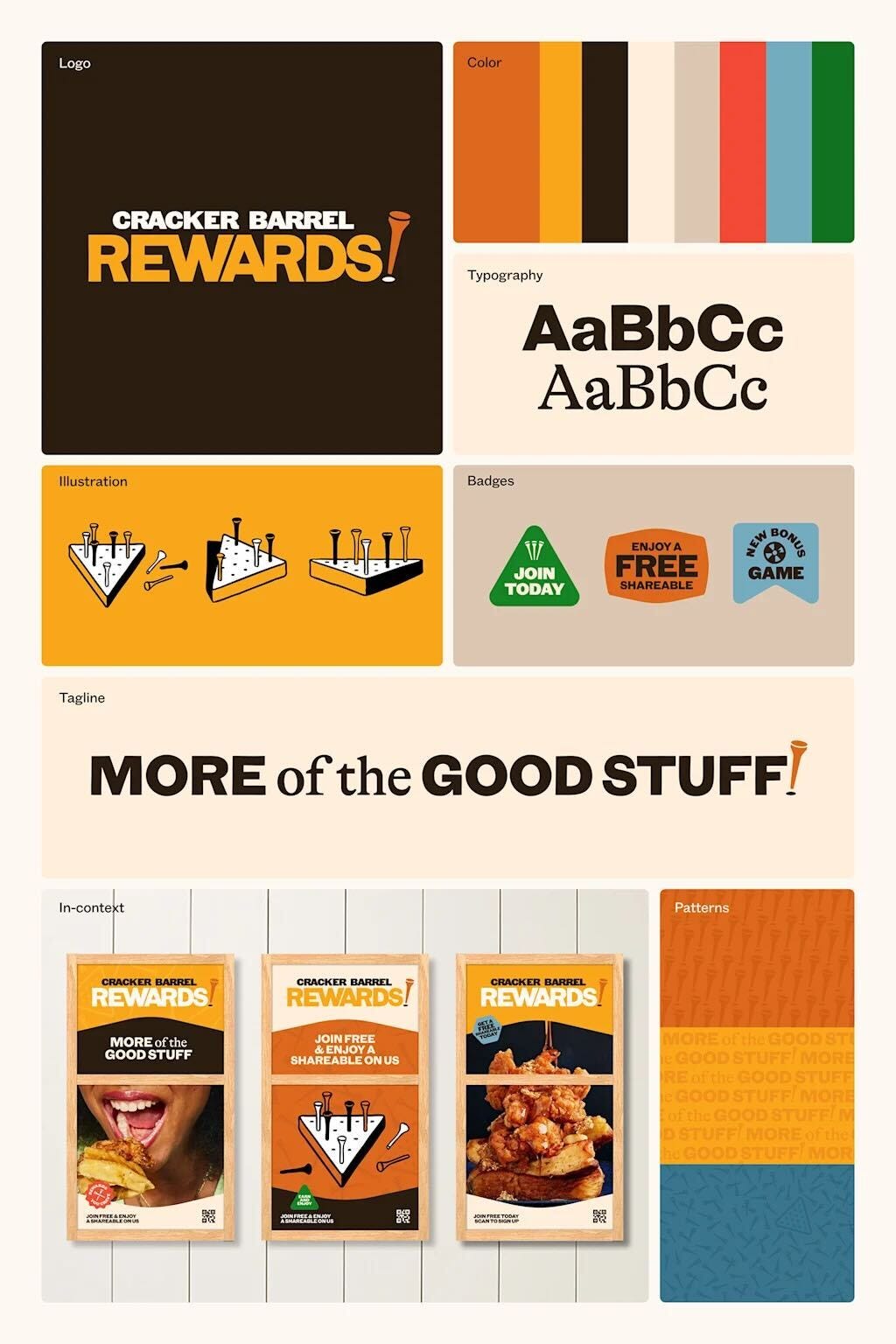
Every ounce of that old country vibe has been removed.

Why?

Inclusivity.

Celebrating a particular culture or a particular place is not inclusive.

A person cannot be the mascot because that’s not inclusive.
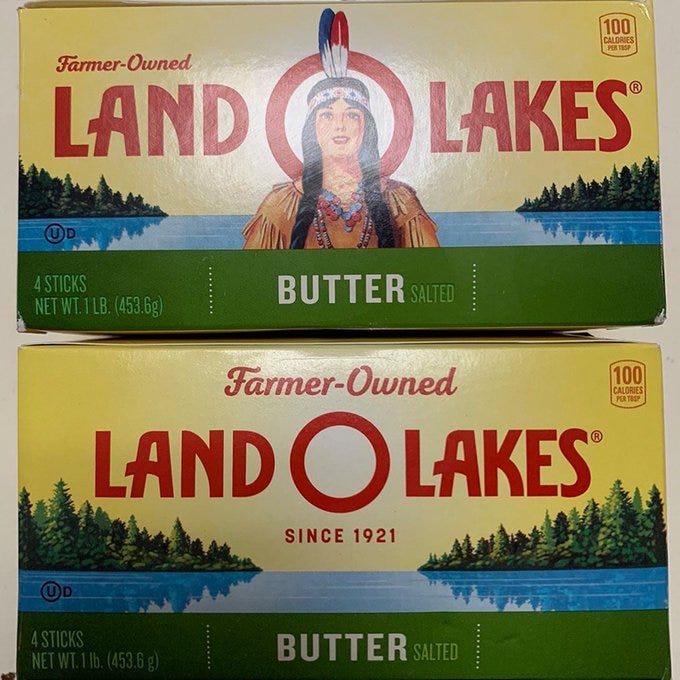
As a designer, I don’t hate Cracker Barrel’s new brand. It’s clean, competent, forgettable. If I saw it on a Chipotle spinoff serving “modern American,” I’d think, sure, looks fine. But that’s exactly the problem. It could belong to anyone. It says nothing.

Lest you think that it needed to be this way, look at KFC’s rebrand.
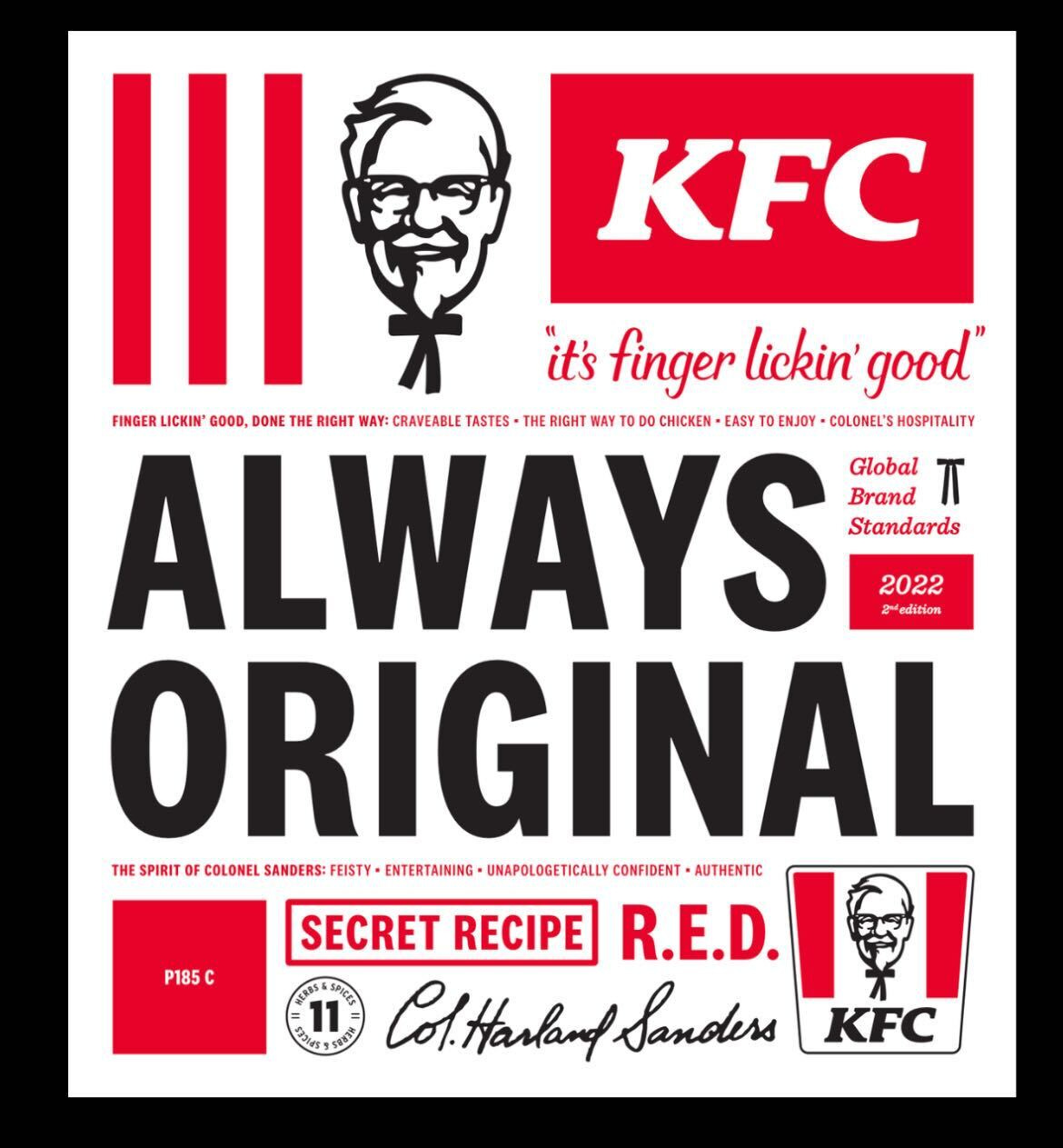
They found a way to evolve the brand for modern marketing uses without destroying its meaning.

But let’s be honest: eventually they’ll come for the Colonel too. In the current system, a white Southern man cannot remain a corporate mascot for long, not when the likes of Masino and Heinerscheid run the boardroom. These girl-bosses’ entire careers depend on neutering particularity.
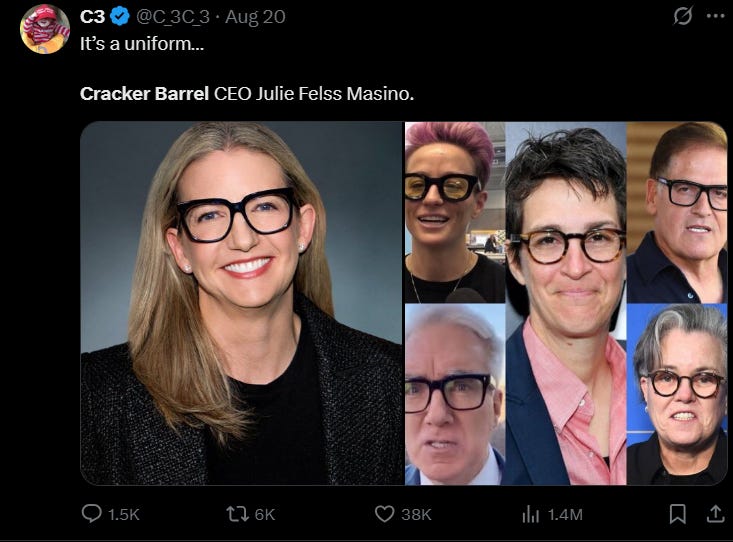
Because that’s what corporate America hates most: Americans. Real ones. People are attached to their own country, their own neighborhoods, their own history. Patriotism and rootedness are “exclusionary,” and thus must be scrubbed. The executives replacing them aren’t builders; they’re talkers. Their whole job is to sound good: in media hits, in boardrooms, in stakeholder calls. Non-offensiveness isn’t just what their careers are built on; it’s their entire personality.

Which is why this rebrand isn’t just aesthetic. It’s political.

The “chimp out” and what it shows about right-wing power

This is why Americans decided to die on the hill of this rebrand, and they are right to.

There is precious little that the average American can do when confronted with the power of BlackRock and Vanguard.

But so long as there is social media, they can storm its beachheads with poasts and memes, the best of which I’ve collected here below:
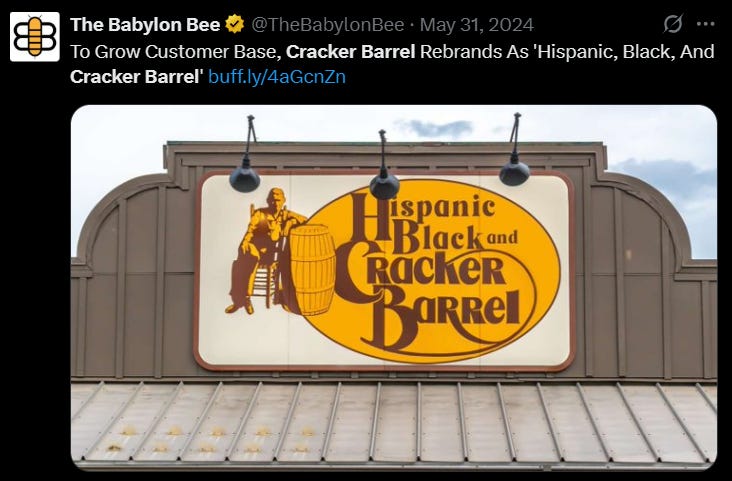
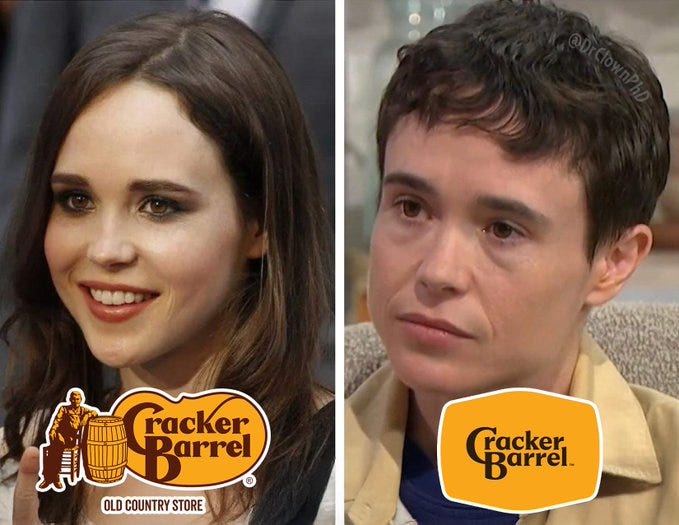
Not only can Americans vote with their memes, they can also vote with their dollars.

This chimp-out led to a catastrophic 10% drop in stock value, resulting in a $ 200 million loss in a single day.
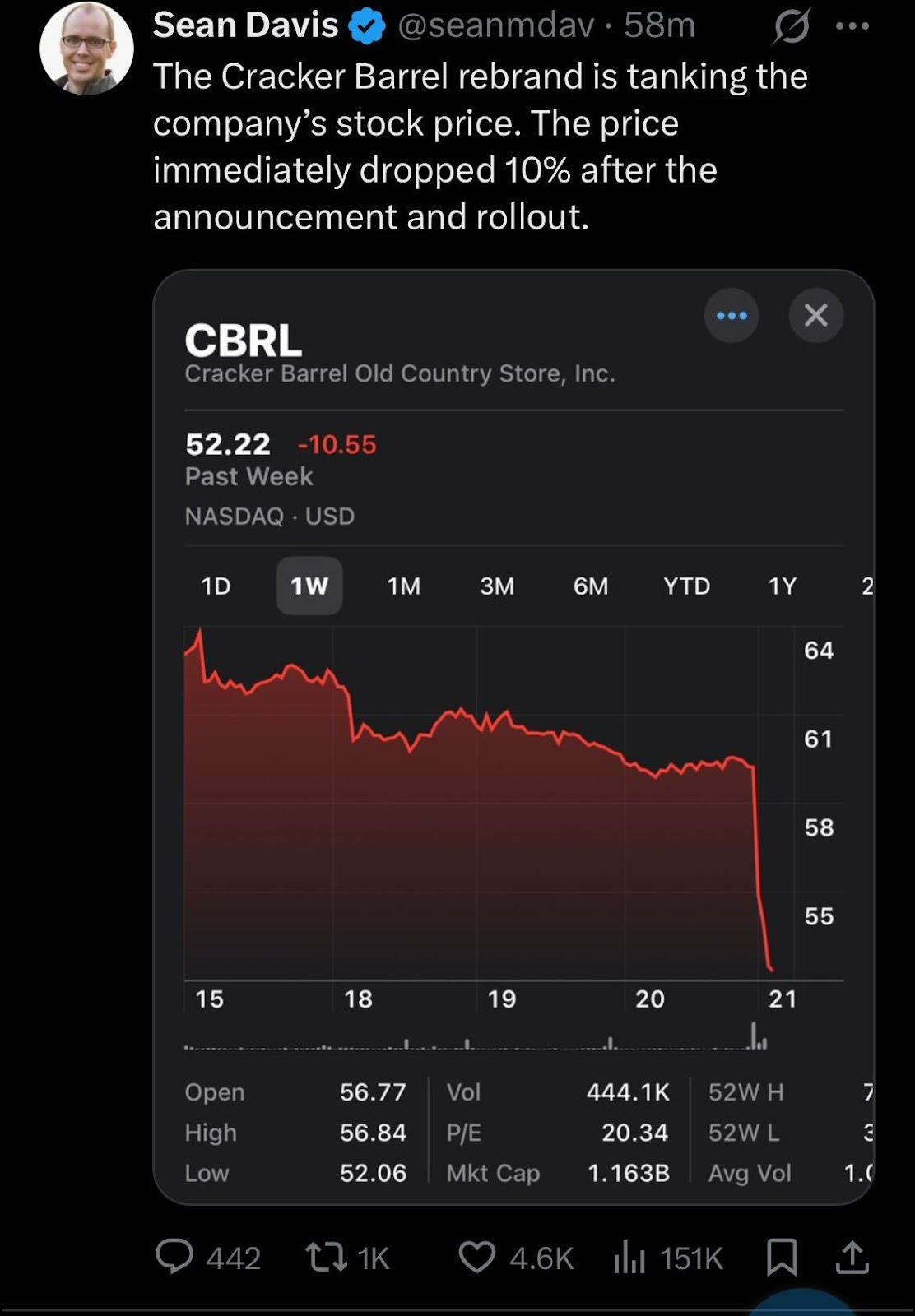
Despite what the doomers say, the right isn’t losing steam; it’s gaining it. The fact that memelords, online posters, and retail investors can trigger a 10% stock drop in 24 hours is no small thing.

We’re still fighting from the underdog position with the air cover of a free bird and the Trump regime. Every win must be celebrated and capitalized on. The energy may have already shifted to the next outrage, but the signal was clear: America spoke.

How Cracker Barrel responds remains to be seen. I wouldn’t bet on an apology… or on the brand’s future.

But as the saying goes, everyone loves a winner. In this battle, the right dominated so thoroughly that even the Democrat x account joined the pile-on.
What this victory means in the context of the culture war

Amidst all the hilarity, the sharpest take on this whole debacle came from Auron MacIntyre

“Now you might ask yourself if capitalism is working as intended how does this person come to run Cracker Barrel? That question should keep you up at night.”

After reading this, I searched, out of curiosity, for “nationalize Cracker Barrel.” What do you know? Hundreds of posts.

If the right is serious about winning, it can’t stop with a four-year stint in Washington. It has to capture every avenue of power. The meme lords understand this instinctively. Their work is more than trolling. They are actively prying open the Overton window for what comes next.

First, with noticing.
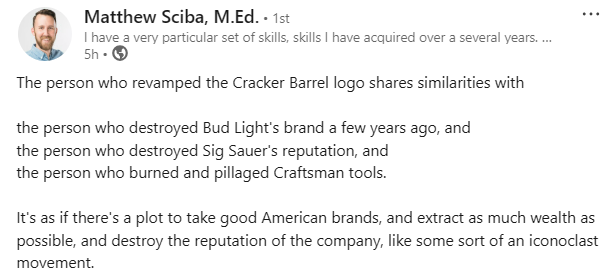
Then with jokes.
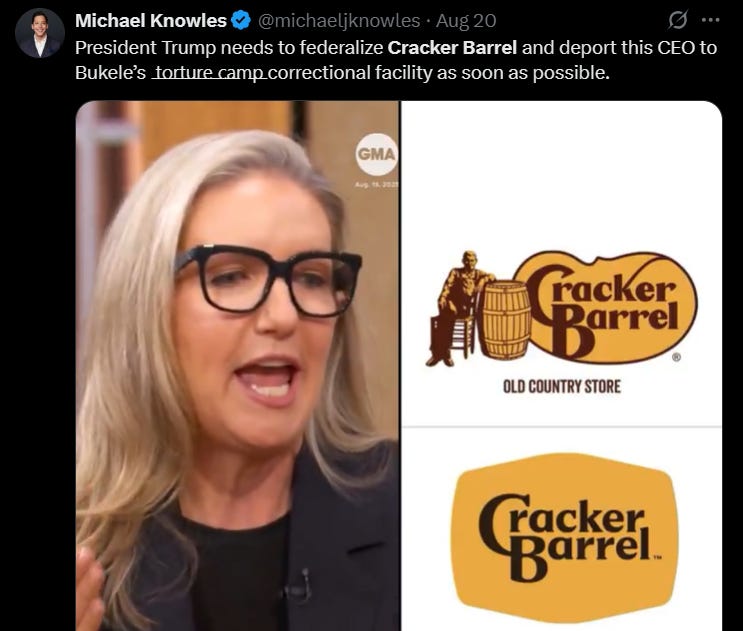
Then, with action.

Update - 8.22.2025

I posted this Substack with a note saying, “In the next 5 years, we’re going to see publicly traded companies get nationalized.”

Not three hours later, Trump announced that the US had taken a controlling 10% interest in Intel.

America’s so-called “free market” is a papier-mache set piece. The populist right is starting to bang on those walls to see if they are real.

We’re about to find out just how flimsy that myth truly is.

“To avoid criticism, say nothing, do nothing, be nothing.”

Aristotle

Heading 1

Heading 2

Heading 3

Heading 4

Heading 5
Heading 6

Lorem ipsum dolor sit amet, consectetur adipiscing elit, sed do eiusmod tempor incididunt ut labore et dolore magna aliqua. Ut enim ad minim veniam, quis nostrud exercitation ullamco laboris nisi ut aliquip ex ea commodo consequat. Duis aute irure dolor in reprehenderit in voluptate velit esse cillum dolore eu fugiat nulla pariatur.

We believe that branding is actually a process of removal, of stripping away what’s already there, which necessitates a marriage of both creative and analytical skills.

Ordered list

  1. Item 1
  2. Item 2
  3. Item 3

Unordered list

  • Item A
  • Item B
  • Item C

Text link

Bold text

Emphasis

Superscript

Subscript

CONTACT US

WE HELP UPSTARTS WIN

We help startups punch above their weight through positioning, brand strategy, websites, investor decks, and growth creative designed to open doors and move the business.

We are a hands-on team of strategists, designers, and creatives who help challengers get clear, get credible, and get moving.
No items found.
No items found.

Heading 1

Heading 2

Heading 3

Heading 4

Heading 5
Heading 6

Lorem ipsum dolor sit amet, consectetur adipiscing elit, sed do eiusmod tempor incididunt ut labore et dolore magna aliqua. Ut enim ad minim veniam, quis nostrud exercitation ullamco laboris nisi ut aliquip ex ea commodo consequat. Duis aute irure dolor in reprehenderit in voluptate velit esse cillum dolore eu fugiat nulla pariatur.

Block quote Block quote Block quote Block quote Block quote Block quote Block quote Block quote Block quote Block quote Block quote

Ordered list

  1. Item 1
  2. Item 2
  3. Item 3

Unordered list

  • Item A
  • Item B
  • Item C

Text link

Bold text

Emphasis

Superscript

Subscript